Home / Services / Opener repair
Garage door opener repair in Sarasota
Most “opener problems” are the door. We check that first.
- Door balance tested first
- Gear kits, not new openers
- Force set right, never raised
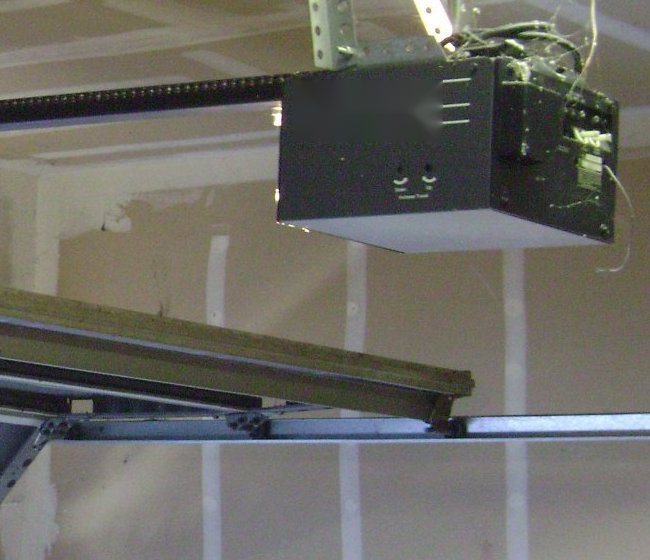
- The motor head, hung from the ceiling.
- The rail and trolley that pull the door.
- The red release cord. Leave it alone if the door is stuck.
- The arm to the top section.
- The photo-eye and its beam near the floor.
Is this you?
Signs it’s the opener, or the door behind it
It hums, but nothing moves
Often a stripped drive gear, which is a part. Or a door so heavy the opener can’t shift it.
It reverses off the floor
The safety system doing its job. Something is binding, and we find what.
Fine at 8 am, refuses at 4 pm
A hot Florida garage trips the thermal cut-out on older motors. Tell us that on the phone.
Door first, opener second
The opener only nudges the door
An opener is a small motor whose job is to nudge a door that its spring already holds almost weightless. When the door goes heavy, the opener is what complains, so it gets the blame.
So the first thing on our visit costs nothing: the opener is disconnected and the door is checked by hand. Please don’t do this yourself, and don’t pull the red release cord; if a spring has gone, the door can drop.
How we do it
How we fix an opener
Balance the door first
With the opener disconnected. A heavy door will eat a new opener too.
Find the actual fault
Gear, limits, logic board, safety eyes or the wiring at the wall.
Repair the part
A gear kit or a board is a part, not a whole new opener.
Set force and travel, then test
Force set to its correct value, then the reverse test with you watching.
What it costs
What an opener repair costs
The visit is $89. Most opener faults are a part, priced before it’s fitted.
Attend and diagnose
$89.00, including the balance test and both safety tests.
Drive gear kit fitted
$150 – $195 including the kit, on common chain and belt units.
Limits and force set correctly
Included in the call-out. Setting the force to its correct value is part of the job; raising it to mask a fault is not something we do at any price.
Safety eye pair replaced
$95 – $130 fitted and aligned.
New opener supplied and fitted
Quoted per unit. It comes with the door balanced first and the old opener taken away.
The details
For the people who want every step
Force is not the same thing as balance
This is the distinction the whole page turns on, and it is worth being clear about because it is where money gets wasted.
Balance belongs to the door. It is the relationship between what the door weighs and how hard the spring is pulling back. Get it right and the door is nearly weightless through its whole travel.
Force belongs to the opener. It is the limit on how hard the motor is allowed to push and pull before it decides something is wrong and stops. On most units it is a pair of adjustments marked up-force and down-force.
Those two get conflated constantly. A door that has gone heavy makes the opener work near its force limit, so the opener trips, strains, hums or reverses. The tempting fix is to raise the force so the opener stops complaining. That works for about a year, during which the motor and the gears are worked past what they were designed for, and it removes the safety margin that made the opener stop in the first place. The correct fix is to make the door light again.
Six inches and stop
The single most common opener complaint, and it is usually not the opener. Two causes:
The up-travel limit may simply be set at six inches, so the opener believes the door is fully open and shuts off. Nothing is broken; the adjustment has drifted or somebody bumped it.
Or the door is binding in the first foot of travel — a bent track, a seized roller, a bottom bracket that has moved — and the opener is hitting its force limit and giving up. That is the safety system doing exactly what it is for. The answer is to find the bind, not to give the opener permission to push through it.
What we repair rather than replace
Drive gear kits
On chain and belt units, the nylon gear that the worm drives is deliberately the weakest part in the chain, so that it fails instead of the motor. When you hear the motor running happily while the door does nothing, that gear has usually shredded. It is a kit, a bit of grease and an hour, not a new machine.
Limits and travel
Older units have screw-driven limit switches; newer ones learn their travel electronically. Either can be set correctly in a few minutes, and it is astonishing how many doors are living with a limit that was set on a hot afternoon and no longer suits.
Safety eyes
Brackets get kicked, lenses get webbed, wires get pinched under a staple. A blinking opener light during a close attempt is nearly always this. What we will not do is bypass them so the door closes.
Receivers, remotes and the antenna
If the remote works at ten feet and not at thirty, look at the wire hanging from the opener head. It is the aerial. It should hang straight down, uncut, not zip-tied to the rail. Cheap LED bulbs in the opener are the other common range killer — they are electrically noisy right next to the receiver.
Wall buttons and wiring
Two thin wires stapled along a wall for twenty years eventually get nicked. An intermittent door that operates by itself is very often a shorting wall-button wire, not a ghost and not a neighbor's remote.
When a new opener is honestly the answer
When the logic board has failed on a unit whose boards are no longer made. When there are no photo-eyes at all, which means it predates the 1993 requirement and cannot be brought up to standard. When the housing is cracked and the rail is bent. In those cases we will say so, and we will still balance the door first, because bolting a new motor above a heavy door is how you buy two openers.
Questions
What people ask us about this
My door opens about six inches and stops. Is the opener dying?
Almost never. Six inches and stop is usually one of two things, and neither is a dead opener. Either the up-travel limit is set wrong, so the opener believes the door is open, or the door is binding in the first few inches and the opener is reversing off the resistance. That is the safety system doing its job. We tell the two apart with the opener disconnected and the door checked by hand, so please don’t turn the force up to push through it.
My door won’t close and the opener light is blinking.
That is nearly always the photo-eyes near the floor. Something is in the beam, one has been knocked out of line, a lens is dirty, or low sun is shining straight into one. Wipe both lenses and check each one points at the other. What we never do is disconnect the eyes to make the door close.
The remote works close up but not from the street.
That is range, and it is usually the antenna wire hanging from the opener (it should hang straight down, not be tied up) or radio noise from a cheap LED bulb in the opener. On most units a weak receiver is a part, not a new opener.
Do you charge to come out?
Yes, $89, and we say it on the phone before you agree to anything. It covers the visit, the diagnosis, the balance test and the safety reverse test, whether or not you go ahead with a repair. A free call-out is never free; it just gets filed somewhere else on the bill.
Want somebody to look at it properly?
Tell us what the door is doing. The owner calls you back with the visit price, and nothing is fitted before you’ve agreed the figure.
Other work