Home / Services / Broken spring repair
Broken garage door spring repair in Sarasota
A single bang, and a door that won’t lift. Don’t touch it. We come to it.
- Winding bars, never screwdrivers
- High-cycle springs by default
- Cables and drums checked too
- A gap in the coil: the spring has broken.
- The winding cone: only ever turned with bars.
- The centre bearing holds the shaft.
- The lift cable now carries the whole door.
Before anything else
If the spring has broken
Don’t lift the door
Its whole weight is now on two thin cables that have just taken a shock.
Don’t run the opener
It will strain against a door it was never meant to lift on its own.
Don’t pull the red cord
The release lets the full weight of the door down. Leave it where it is; we come to it.
Is this you?
Signs the spring has gone
A gap in the coil
Look at the shaft above the opening. A broken spring has a clean two-inch gap, as if a slice were cut out.
One loud bang
Often in the night or while nobody was near the door. It was fine until somebody pressed the button.
The opener strains
It hums, lifts a few inches and gives up. The opener isn’t broken; the door has gone heavy.
Extension springs
Some doors use stretched springs instead
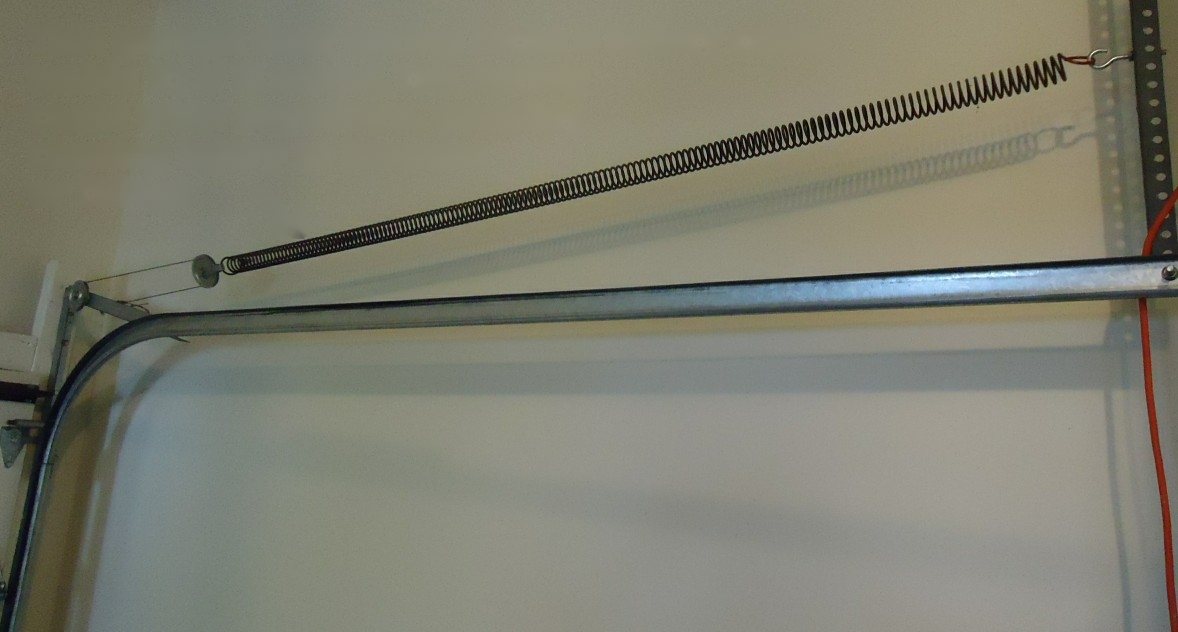
Older and lighter doors often have extension springs running along the tracks on each side, like the one in this picture. They wear out the same way.
An extension spring must have a safety cable threaded through it. Without one, a spring that breaks under tension leaves at speed. With one, the pieces stay on the wire. You can check from the doorway; if yours has none, we fit them.
How we do it
How we replace a spring
The door clamped, the opener unplugged
Nothing moves while we work, and nobody stands under the door.
The old spring unwound with bars
Proper winding bars sized to the cone. Never a screwdriver, never rebar.
A high-cycle spring wound to the turns
Sized by wire, inside diameter and length for your door, unless you ask for standard.
Balanced, then tested with you
The door should hold at waist height. Then the reverse test, twice, before we leave.
Worth knowing before any quote
10,000 cycles, or 25,000
A spring is rated in cycles, and one cycle is one up and one down. Four trips a day is about 1,500 cycles a year.
Standard spring
About 10,000 cycles
Roughly a seven-year part on a household door. Cheaper, and a fair choice if you are selling the house.
What we fit by default
25,000 cycles or more
Closer to sixteen years. A modest amount more for more than twice the life, and the rating goes on your ticket.
What it costs
What a spring repair costs
The visit is $89, said on the phone. The spring is priced by its wire size, inside diameter and length once we’ve seen it.
Attend and diagnose
$89.00, including the balance test and both safety tests whether or not you proceed.
Single torsion spring
$260 – $340 fitted, high-cycle, including balancing the door and re-testing. The range is wire size and length, not a negotiation.
Pair of springs
$420 – $540 fitted. Cheaper than two separate visits, which is why we ask about the second one now rather than in eight months.
Cables, if damaged
$70 – $95 for the pair, fitted at the same time.
The details
For the people who want every step
What has actually happened
A torsion spring does not lift your door. It counterbalances it. When the door is down, the spring is wound tight and holding almost the entire weight of the door as stored energy. As the door rises, the spring unwinds and hands that energy back. Done properly, a 180-pound door feels like eight or ten pounds in your hands the whole way up.
When the spring breaks, that counterbalance vanishes instantly. The door now weighs everything it weighs. Two thin steel cables and a half-horsepower opener are all that is between it and the floor, and neither is designed for the job. This is why the advice above is not caution for the sake of it: people are hurt every year lifting a door with a broken spring, and people are hurt every year trying to wind a new one in without bars.
Why we will not talk you through it
Winding a torsion spring means putting a solid steel bar into a hole in the winding cone, taking the load, and turning the cone through a precise number of quarter turns while moving the second bar into the next hole. The bars must be the right diameter for the cone and long enough to give control. Screwdrivers slip. Rebar bends. A socket extension will fold and let the cone go, and when a cone goes it unwinds through whatever is in front of it.
There is no version of this conversation on the phone that ends well, so we do not have it. If we cannot get to you soon enough, we will say so and you can call somebody else — just ask them whether they own winding bars, and take the answer seriously.
One spring or two
Some doors have a single spring, some have a pair. If a door was built with two and one has gone, the other is the same age and has done the same number of cycles. It is very often within months of going itself. We will tell you the price for one and for both, and we will not pretend the second one is urgent if it is genuinely new — but on a matched pair fitted at the same time, changing only one is usually false economy, and if that is what you choose it goes on the ticket so nobody is surprised later.
What gets replaced with it
A spring rarely breaks quietly. When it lets go, the door drops until the cables catch, and that shock goes straight into the cables, the drums and the bottom brackets. So before we estimate a total we look at all three.
Cables
A cable that has taken a shock often has a strand or two that has started to lift — you can see it bird-caging away from the lay of the wire. That cable will fail, and it is a fraction of the price of the spring.
Drums
If the cables jumped their grooves when the door dropped, the drums need re-seating and setting to the same mark on both sides so the door comes up square. A drum that has been chewed by a loose cable gets replaced.
Bearings and the shaft
The center bearing plate and the two end bearings turn every cycle for years and are cheap. If one is dry or notchy while the shaft is already coming apart, it goes in.
What goes in
Unless you tell us otherwise, a 25,000-cycle spring in place of the 10,000-cycle part that usually comes out. On a door opened four times a day that is roughly sixteen years instead of seven. The wire size, inside diameter, length, wind direction and rating go on your ticket.
Then the door is balanced by hand with the opener disconnected. It should hold at waist height. A spring wound to the wrong number of turns is the most common reason a brand new spring feels wrong, and it is the last thing checked before the opener goes back on.
Questions
What people ask us about this
Can you talk me through replacing the spring myself?
No. It’s the one thing we are rigid about. A torsion spring holds the whole weight of the door as wound steel, and winding it takes proper winding bars. Screwdrivers and rebar slip, and when one slips the cone unwinds through whatever is in front of it. We would rather drive out, and if we can’t get to you soon enough, we’ll say so.
How long does a spring replacement take?
On a standard home door with the spring on the truck, about forty-five minutes to an hour, including balancing the door and running both safety tests. What adds time is a cable or drum damaged when the spring let go, which is why we look at both before we price the job.
What is a cycle rating, and which spring should I get?
A torsion spring is rated in cycles, and one cycle is one open and one close. A standard spring is around 10,000 cycles; a high-cycle spring is 25,000 or more. A household that uses the door four times a day runs about 1,500 cycles a year, so that is roughly seven years against sixteen. We fit high-cycle by default, and a standard spring if you ask. The rating goes on your ticket either way.
What is the difference between torsion and extension springs?
Torsion springs sit on a shaft above the opening and wind up as the door comes down. Extension springs run along the tracks on each side and stretch. Extension springs are still common on older, lighter doors, and they must have a safety cable run through the middle, so a spring that breaks stays threaded on the wire instead of flying across the garage.
Want somebody to look at it properly?
Tell us what the door is doing. The owner calls you back with the visit price, and nothing is fitted before you’ve agreed the figure.
Other work