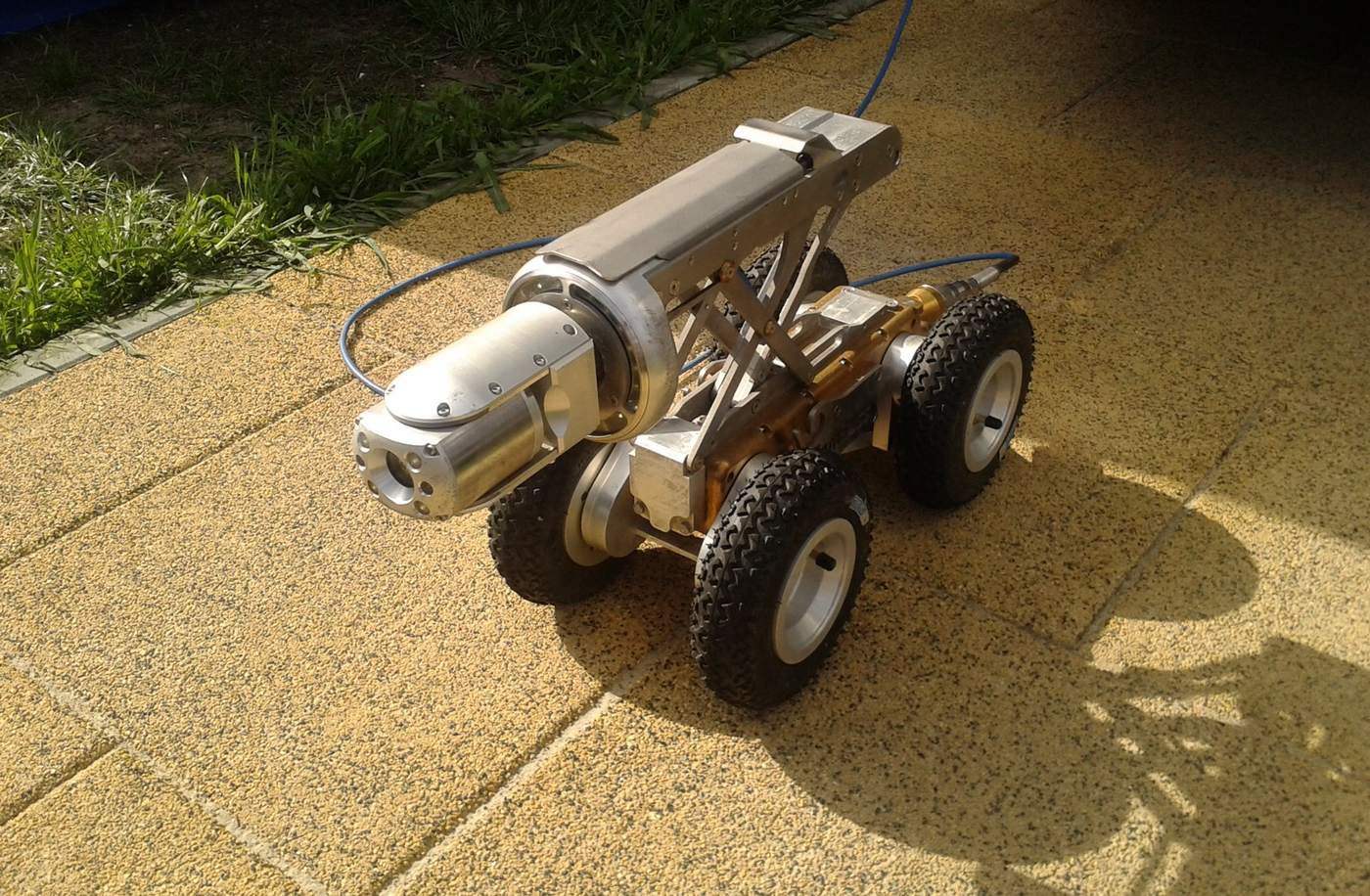
Sewer camera inspection in Casselberry
Every foot of the line on a screen you’re standing at. What we find is written down at its footage and depth, and the recording is yours.
What you see on the screen
Five foot marks from one run
Tap a foot mark to see what the camera saw there, with the footage and the depth over the picture.
Drawn from the run sheet of one job in Casselberry: 63 feet, cleanout to city main.
Run CR-2208, in full
Sixty-three feet, one foot mark at a time
Ten entries, in the order the camera saw them. Two are defects, and only one of them is why the line keeps backing up.
The customer stood at the screen for all of it, and went home with the recording and this sheet.
- 0.0 ft30 in below grade
Two-way cleanout, camera in
Four-inch cleanout at the south foundation wall, cap off, camera in and pointed downstream toward the city main. A two-way cleanout is the difference between this visit and one that starts by pulling a toilet.
Access - 5.0 ft31 in below grade
Cast iron ends, clay begins
Cast iron under the slab, clay from the foundation out: ordinary for a 1974 house here. The two fail differently. Iron corrodes from the inside; clay stays hard and fails at its joints.
Transition - 11.0 ft32 in below grade
Fine root hairs at a joint
Hair roots through a bell joint, about a tenth of the bore. Worth writing down, and not worth digging for.
Noted, not a defect - 18.5 ft33 in below grade
Cut root ends and fresh cable marks
This is where the cable has been, twice, in March and in July. Nothing here explains why the roots came back in four months.
Evidence of prior work - 27.0 ft35 in below grade
The camera goes under
The picture goes green and the head is submerged. Water stands where the pipe stops falling. From here to 41 ft we are reading through water.
Water begins - 33.0 ft37 in below grade
The low point: two inches of standing water
The bottom of the belly. Half the pipe is gone before anything is flushed into it. The cause is under the pipe, bedding that settled, and no cable or jet lifts a pipe back up.
Bellied line - 41.0 ft35 in below grade
Out of the water
The belly is fourteen feet long and about two inches deep at worst. A four-inch sewer may fall as little as an eighth of an inch per foot, so there was almost no slope to lose.
Water ends - 47.5 ft41 in below grade
Offset joint: a lip across the bore, roots coming in
One section has dropped at its bell and left a lip across the bottom of the pipe. The joint is open to the soil, and it is the only opening on this run big enough to explain four months. Located from the surface: 41 inches down, six feet off the front walk, painted and flagged.
This is the cause - 58.0 ft48 in below grade
Clay in good order, joints closed
Seventeen feet of pipe with nothing wrong with it. Most of this line does not need replacing, and we say so.
Sound - 63.0 ft52 in below grade
The connection to the city main
Camera out. Sixty-three feet, recorded, and the copy of the recording goes with the customer.
End of run
Is this you?
When a camera run is worth it
The line has backed up before
A second or third backup in a year means something is catching in the same place.
You’re buying an older house
Know what’s under the lawn before you own it: pipe material, joints and any sag.
Someone quoted a big repair
Before paying for a new line, see the footage the quote is based on, or get some.
How we do it
How a camera run goes
In at the cleanout
The camera head goes in at the cleanout and is fed down the line toward the city main.
Everything at its footage
Roots, joints, standing water and pipe changes are each written down where they were found.
Located and flagged
Any defect worth repairing is found from the surface, painted and flagged with its depth.
The sheet and the recording
You leave with both, so the next contractor can agree or disagree with us.
What it costs
What a camera run costs
The camera run has one price, given on the phone. A repair is priced separately, after you’ve seen what we saw.
One price for the run
Cleanout to city main, recorded, with a written run sheet. You hear the price before we come.
Locating is its own line
Marking a defect on the lawn with its depth is listed separately, so you can see what it adds.
No repair pressure
Most of a line is usually good pipe. If it’s one joint, the quote is for one joint.
The details
For the people who want every step
What it is
A self-levelling camera head on a stiff push rod goes in at the cleanout and is fed down the line. The picture carries a footage counter, so every single thing seen has a distance attached to it. The head also carries a transmitter — a sonde — which a receiver above ground can find, giving a mark on the lawn and a depth in inches.
That second half is the half most people never get, and it is the half a repair is priced from. Knowing there is an offset joint is interesting. Knowing it is at 47.5 feet and forty-one inches down, six feet off the front walk, is the difference between a six-foot hole and a trench across a garden.
What has to be on the run sheet
| Written down | Why it has to be there |
|---|---|
| Start point and direction | “From the cleanout, downstream”. A run described from the wrong end is unrepeatable. |
| Total distance run | Tells you how much of the line was seen — and how much was not. |
| Pipe material, and where it changes | Cast iron and clay and PVC fail differently. The transition point is a real location. |
| Every observation, at its footage | A finding without a distance cannot be dug to and cannot be checked. |
| Depth at any defect, in inches | What the repair is priced from, and what tells you if anything else is in the way. |
| Where water stands, and how deep | Standing water is the signature of a sag, and its length is the size of the problem. |
| What was not seen | Submerged pipe is not clean pipe. Saying so is the difference between a report and a sales tool. |
You should leave with the recording. We hand over a copy as a matter of course, because a recording is what lets the next contractor disagree with us.
What a camera cannot do, said plainly
It cannot see through water. In a bellied line, the camera goes under and the picture is green, and a fourteen-foot section gets written down as “submerged” rather than as sound pipe — because nobody knows. It cannot see the outside of the pipe, so it cannot tell you how much soil has washed out around an open joint. It does not measure slope; it tells you where water sits, which is a blunter and more useful thing. And it cannot see past a full blockage, so on a line that is actually stopped, the cable goes first and the camera goes second.
When we will tell you not to bother
A first-time block on a PVC line with an obvious cause — a wipe, a toy, the thing you can already see on the cable — does not need a camera, and offering one is an upsell with a lens on it. We run the camera when the line has done this before, when the house is old enough for the material to be in question, when a repair is about to be quoted, or when somebody is buying the house and wants to know what is under the lawn before they own it.
Questions
What people ask us about this
What can’t a camera see?
It can’t see through standing water, so a sag is written down as “submerged” rather than called clean. It can’t see the outside of the pipe, and it can’t see past a full blockage, so on a stopped line the cable goes first.
Do I get to keep the recording?
Yes, every time. A recording is what lets the next contractor check our work, and we’d rather it held up.
Do you call in utility locates before digging?
Always. Our transmitter finds our pipe, not the power, gas or cable crossing it. Sunshine 811 is called and waited for, two full business days, before anybody digs.
Want somebody to look at it properly?
Tell us what it’s doing. The office calls you back the same working day to agree a time. Nothing is priced before somebody has seen it, and you keep whatever we write down.
Other work