
Tree cabling and bracing in Sarasota
Steel cable and rods for a split trunk or a weak fork, and an honest answer about how much time they buy.
Is this you?
Signs a fork needs support
Two trunks the same size
Co-dominant stems growing from one fork, often with bark pinched in the seam.
A crack at the union
A seam that’s opening, or weeps after rain.
Something below worth protecting
A roof or a patio under the heavier side.
How we see it
Hardware buys a tree time. It does not make it sound.
Cables and rods are a way of managing a structural defect that is not going to correct itself. They are worth doing on the right tree, and they are worth understanding before you agree to them, because they commit you to an inspection schedule for the rest of the tree’s life.
- A cable high in the crown, about two-thirds of the way up, limits how far the stems can spread.
- A rod through a union that has already started to separate, always with a cable above.
- Usually paired with a reduction of the weight above the union.
How we do it
How a tree is cabled
Assess the union
How far the defect has gone decides whether hardware helps or removal is the honest answer.
Reduce the load
Shortening the heavy ends often does more good than the hardware.
Install the system
Steel cable and through-hardware, or a synthetic dynamic system on younger trees.
Put it on a schedule
An inspection every year and after storms, recorded against the install date.
What it costs
What cabling costs
Priced per tree on the scope, hardware and any reduction as separate lines.
How many cables
One cable between two stems, or a system across several.
Rods
A rod through a split union is its own line.
The weight above
A reduction alongside is priced separately so you can see the difference.
The details
For the people who want every step
The defect they exist for
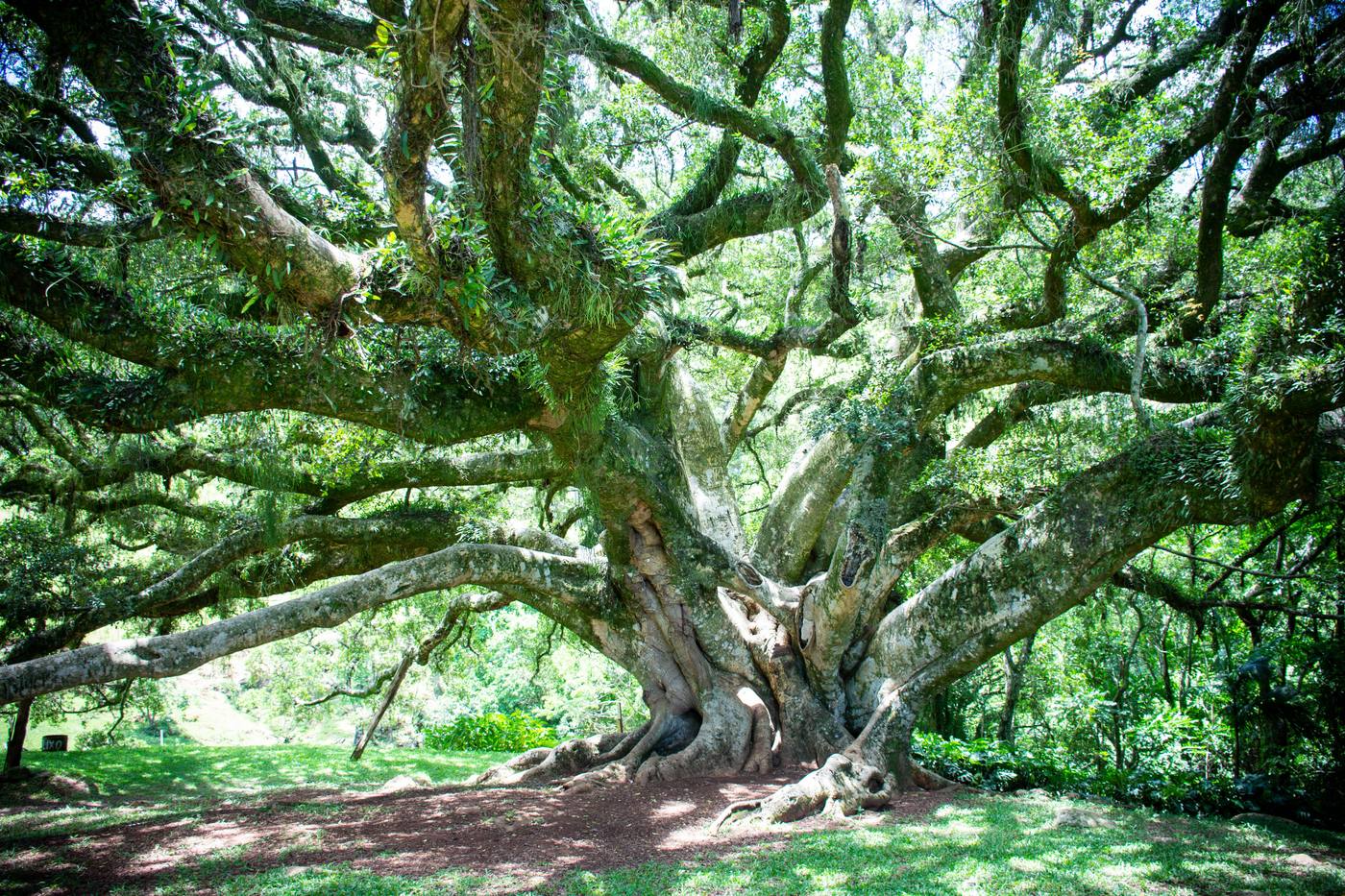
When a tree grows two stems of roughly equal size up from the same point — codominant stems — neither is subordinate, and the union between them is weaker than a normal branch attachment. Sometimes far weaker, because of included bark.
In a sound union, the branch and the trunk lay down interlocking wood fibers each year, and the union gets stronger as it gets bigger. You can see it from below as a raised ridge of bark pushing up out of the crotch: the branch bark ridge. In an included union, the two stems press together so tightly that bark gets trapped between them and no wood fiber connection forms at all. The seam runs downward instead of ridging upward, and the union is essentially two trees leaning on each other, held by whatever wood formed around the outside.
They fail, and when they fail they usually split down the trunk rather than breaking cleanly, which frequently ends the tree. It is the most common serious structural defect on mature oaks here.
What a cable does
A cable is installed high in the tree — conventionally about two-thirds of the way from the union to the ends of the limbs it joins — and it limits how far those limbs can move apart. That is all it does. It does not pull the union together, does not repair anything, and does not carry the tree’s weight. It reduces the range of motion so the union sees less stress in a gust.
Height matters enormously. The same cable installed halfway down does far less, because leverage is everything: the further out the restraint, the less force it takes to control the movement.
Two systems
Static systems are steel cable, with either eye bolts through the stems or amon-style anchors, depending on the standard being worked to. They allow almost no movement across the union. Used where a defect is advanced and movement is what you are trying to stop.
Dynamic systems are hollow-braid synthetic rope with a shock-absorbing section, installed without drilling into the tree. They allow normal movement and only take load at the extremes. The argument for them is that a tree that keeps moving keeps laying down reaction wood, so it keeps getting stronger, where a rigidly braced tree stops adapting. The argument against is that on a badly included union you may not want any movement at all.
Both are legitimate. Which one depends on the defect, and anybody who only installs one of them will recommend that one.
Bracing rods
A brace rod is a threaded steel rod driven through the union itself, above or below or through the split, to stop the two halves from moving relative to each other. It is used where a union has already begun to separate, and it is normally installed with a cable above it — the rod holds the union, the cable takes the leverage off it. A rod alone in a union that is still being levered by fifty feet of limb above it is a bolt waiting to tear out.
The honest limits
- Hardware does not fix decay. If the wood the anchors are set into is decaying, the anchor has nothing to hold. A cable through rotten wood is worse than no cable, because it looks like a solution.
- It does not make the tree safe. It lowers the likelihood of one specific failure mode. Every other failure mode is exactly where it was.
- It is not permanent and not fit-and-forget. Hardware needs inspecting — annually is the normal recommendation, and after any significant storm. Cables loosen as the tree grows, anchors can become engulfed, synthetic rope degrades in ultraviolet light. A twenty-year-old cable nobody has looked at is not doing what its owner believes it is doing.
- It nearly always needs pruning with it. Reducing end weight on the limbs above the union is usually the larger part of the benefit, and sometimes it is enough on its own. See crown reduction.
- It commits future owners. If you sell the house, the hardware and its inspection schedule go with the tree, and the next owner has to be told it is there.
The cheaper answer, when the tree is young
Codominant stems are made, not born. A young tree with two competing leaders can be corrected with hand pruners in a few minutes: shorten the weaker stem so the stronger one becomes the leader, and repeat once or twice over the following years. It is called subordination, it costs almost nothing, and it eliminates the defect that would otherwise need steel at year thirty. Nobody sells it, because nobody is worried about a tree that small yet.
What goes on the card. Type of system, where it is installed, what it is anchored into, the date, and the inspection interval. Written down, because the person who needs it most is whoever looks at this tree in fifteen years.
How it’s specified on the scope
| The defect | Codominant stems, usually with included bark: a seam pushing inward instead of a raised branch bark ridge. |
|---|---|
| Cable placement | High — conventionally about two thirds of the distance from the union to the limb tips. |
| Static system | Steel cable and through-hardware. Minimal movement. For advanced defects. |
| Dynamic system | Synthetic hollow-braid with a shock absorber, no drilling. Allows adaptive growth. |
| Brace rods | Threaded rod through a union that has already begun to separate. Always with a cable above it. |
| Inspection | Annually, and after any significant storm. Recorded with the installation date. |
| What it does not do | Repair the union, arrest decay, carry weight, or make the tree safe. |
| Usually paired with | Reduction of end weight above the union — often the larger share of the benefit. |
| Cheaper, earlier | Subordination pruning on a young tree removes the defect before it exists. |
Questions
What people ask us about this
Does cabling make my tree safe?
No. It buys time by limiting how far the stems can move. It doesn’t repair the union, stop decay or make the tree sound, and we say that before you agree to it.
How long does it last?
With yearly inspections, years. Hardware is checked and adjusted as the tree grows, and replaced when it needs to be.
Can a young tree avoid this?
Yes. Pruning one of the two stems back while it’s young removes the defect before it exists. It’s far cheaper than hardware later.
Is the tree too far gone?
Sometimes. If the union has already split through, hardware isn’t honest, and we’ll talk about removal or reducing the target instead.
Want somebody to look at it properly?
Tell us what the tree is doing. The owner calls you back to set a time to walk it, and nothing is priced before somebody has stood under it.
Other work